For the following questions answer them individually
The characteristic distance at which quantum gravitational effects are significant, the Planck length, can be determined from a suitable combination of the fundamental physical constants G, h and c. Which of the following correctly gives the Planck length?
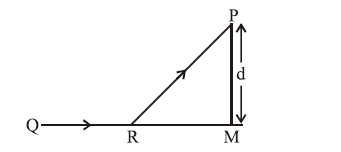
A man in a car at location Q on a straight highway is moving with speed v. He decides to reach a point P in a field at a distance d from highway (point M) as shown in the figure. Speed of the car in the field is half to that on the highway. What should be the distance RM, so that the time taken to reach P is minimum?
A body of mass 2 kg slides down with an acceleration of 3 m/s$$^2$$ on a rough inclined plane having a slope of 30$$^\circ$$. The external force required to take the same body up the plane with the same acceleration will be: (g = 10 m/s$$^2$$)
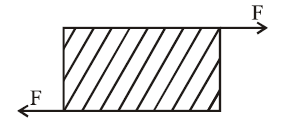
As shown in the figure, forces of $$10^5$$ N each are applied in opposite directions, on the upper and lower faces of a cube of side 10 cm, shifting the upper face parallel to itself by 0.5 cm. If the side of another cube of the same material is, 20 cm then under similar conditions as above, the displacement will be:
A disc rotates about its axis of symmetry in a horizontal plane at a steady rate of 3.5 revolutions per second. A coin placed at a distance of 1.25 cm from the axis of rotation remains at rest on the disc. The coefficient of friction between the coin and the disc is (g = 10 m/s$$^2$$)
A proton of mass m collides elastically with a particle of unknown mass at rest. After the collision, the proton and the unknown particle are seen moving at an angle of 90$$^\circ$$ with respect to each other. The mass of unknown particle is:
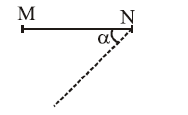
A thin rod MN, free to rotate in the vertical plane about the fixed end N, is held horizontal. When the end M is released, the speed of this end, when the rod makes an angle $$\alpha$$ with the horizontal, will be proportional to: (see figure)
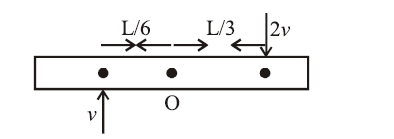
A thin uniform bar of length L and mass 8 m lies on a smooth horizontal table. Two point masses m and 2 m moving in the same horizontal plane from opposite sides of the bar with speeds 2v and v respectively. The masses stick to the bar after collision at a distance $$\frac{L}{3}$$ and $$\frac{L}{6}$$ respectively from the centre of the bar. If the bar starts rotating about its center of mass as a result of collision, the angular speed of the bar will be:
When an air bubble of radius r rises from the bottom to the surface of a lake, its radius becomes $$\frac{5r}{4}$$. Taking the atmospheric pressure to be equal to 10 m height of water column, the depth of the lake would approximately be (ignore the surface tension and the effect of temperature):
A body takes 10 minutes to cool from 60$$^\circ$$C to 50$$^\circ$$C. The temperature of surroundings is constant at 25$$^\circ$$C. Then, the temperature of the body after next 10 minutes will be approximately
Two Carnot engines A and B are operated in series. Engine A receives heat from a reservoir at 600 K and rejects heat to a reservoir at temperature T. Engine B receives heat rejected by engine A and in turn rejects it to a reservoir at 100 K. If the efficiencies of the two engines A and B are represented by $$\eta_A$$ and $$\eta_B$$ respectively, then what is the value of $$\frac{\eta_A}{\eta_B}$$?
The value closest to the thermal velocity of a Helium atom at room temperature (300 K) in ms$$^{-1}$$ is: [k$$_B$$ = 1.4 $$\times$$ 10$$^{-23}$$ J/K; m$$_{He}$$ = 7 $$\times$$ 10$$^{-27}$$ kg]
Two simple harmonic motions, as shown, are at right angles. They are combined to form Lissajous figures. $$x(t) = A\sin(at + \delta)$$, $$y(t) = B\sin(bt)$$. Identify the correct match below.
5 beats/second are heard when a turning fork is sounded with a sonometer wire under tension, when the length of the sonometer wire is either 0.95 m or 1 m. The frequency of the fork will be:
A solid ball of radius R has a charge density $$\rho$$ given by $$\rho = \rho_0\left(1 - \frac{r}{R}\right)$$ for $$0 \leq r \leq R$$. The electric field outside the ball is:
A copper rod of cross-sectional area A carries a uniform current I through it. At temperature T, if the volume charge density of the rod is $$\rho$$, how long will the charges take to travel a distance d?
A parallel plate capacitor with area 200 cm$$^2$$ and separation between the plates 1.5 cm, is connected across a battery of emf V. If the force of attraction between the plates is $$25 \times 10^{-6}$$ N, the value of V is approximately: $$\left(\varepsilon_0 = 8.85 \times 10^{-12} \frac{C^2}{N \cdot m^2}\right)$$
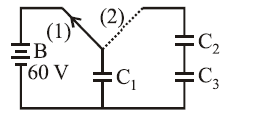
A capacitor C$$_1$$ is charged up to a voltage V = 60 V by connecting it to battery B through switch (1). Now C$$_1$$ is disconnected from battery and connected to a circuit consisting of two uncharged capacitors C$$_2$$ = 3.0$$\mu$$F and C$$_3$$ = 6.0$$\mu$$F through a switch (2) as shown in the figure. The sum of final charges on C$$_2$$ and C$$_3$$ is:
A constant voltage is applied between two ends of a metallic wire. If the length is halved and the radius of the wire is doubled, the rate of heat developed in the wire will be:
A current of 1 A is flowing on the sides of an equilateral triangle of side $$4.5 \times 10^{-2}$$ m. The magnetic field at the centre of the triangle will be:
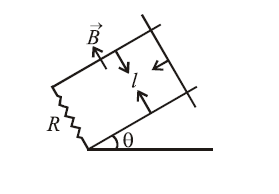
A copper rod of mass m slides under gravity on two smooth parallel rails, with separation l and set at an angle of $$\theta$$ with the horizontal. At the bottom, rails are joined by a resistance R. There is a uniform magnetic field B normal to the plane of the rails, as shown in the figure. The terminal speed of the copper rod is:
At the centre of a fixed large circular coil of radius R, a much smaller circular coil of radius r is placed. The two coils are concentric and are in the same plane. The larger coil carries a current I. The smaller coil is set to rotate with a constant angular velocity $$\omega$$ about an axis along their common diameter. Calculate the emf induced in the smaller coil after a time t of its start of rotation.
A plane polarized monochromatic EM wave is travelling a vacuum along z direction such that at t = t$$_1$$ it is found that the electric field is zero at a spatial point z$$_1$$. The next zero that occurs in its neighbourhood is at z$$_2$$. The frequency of the electromagnetic wave is:
A convergent doublet of separated lenses, corrected for spherical aberration, has resultant focal length of 10 cm. The separation between the two lenses is 2 cm. The focal lengths of the component lenses are:
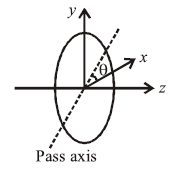
A plane polarized light is incident on a polariser with its pass axis making angle $$\theta$$ with x-axis, as shown in the figure. At four different values of $$\theta$$, $$\theta$$ = 8$$^\circ$$, 38$$^\circ$$, 188$$^\circ$$ and 218$$^\circ$$, the observed intensities are same. What is the angle between the direction of polarization and x-axis?
If the de Broglie wavelengths associated with a proton and an $$\alpha$$-particle are equal, then the ratio of velocities of the proton and the $$\alpha$$-particle will be:
Muon ($$\mu^{-1}$$) is negatively charged (|q| = |e|) with a mass m$$_\mu$$ = 200 m$$_e$$, where m$$_e$$ is the mass of the electron and e is the electronic charge. If $$\mu^{-1}$$ is bound to a proton to form a hydrogen like atom, identify the correct statements:
(A) Radius of the muonic orbit is 200 times smaller than that of the electron
(B) The speed of the $$\mu^{-1}$$ in the nth orbit is $$\frac{1}{200}$$ times that of the electron in the nth orbit
(C) The ionization energy of muonic atom is 200 times more than that of an hydrogen atom
(D) The momentum of the muon in the nth orbit is 200 times more than that of the electron
An unstable heavy nucleus at rest breaks into two nuclei which move away with velocities in the ratio of 8 : 27. The ratio of the radii of the nuclei (assumed to be spherical) is:
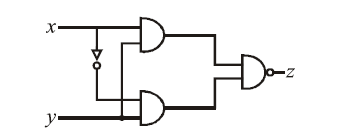
Truth table for the given circuit will be:
The carrier frequency of a transmitter is provided by a tank circuit of a coil of inductance 49$$\mu$$H and a capacitance of 2.5 nF. It is modulated by an audio signal of 12 kHz. The frequency range occupied by the side bands is: