For per gram of reactant, the maximum quantity of N$$_2$$ gas is produced in which of the following thermal decomposition reactions? (Given: Atomic wt. : Cr = 52u, Ba = 137u)
 JEE WhatsApp Group
Sign in
Please select an account to continue using cracku.in
↓ →
JEE WhatsApp Group

Join Our JEE Preparation Group
Prep with like-minded aspirants; Get access to free daily tests and study material.
For per gram of reactant, the maximum quantity of N$$_2$$ gas is produced in which of the following thermal decomposition reactions? (Given: Atomic wt. : Cr = 52u, Ba = 137u)
Login to view the detailed solution.
The de-Broglie's wavelength of electron present in first Bohr orbit of 'H' atom is:
Login to view the detailed solution.
The correct order of electron affinity is:
Login to view the detailed solution.
.webp)
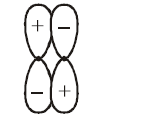
Which of the following best describes the diagram of molecular orbital?
$$\Delta_r G^\circ$$ at 500 K for substance 'S' in liquid state and gaseous state are +100.7 kcal mol$$^{-1}$$ and +103 kcal mol$$^{-1}$$, respectively. Vapour pressure of liquid 'S' at 500 K is approximately equal to: (R = 2 cal K$$^{-1}$$ mol$$^{-1}$$)
Given (i) 2Fe$$_2$$O$$_3$$(s) $$\rightarrow$$ 4Fe(s) + 3O$$_2$$(g); $$\Delta_r G^\circ$$ = +1487.0 kJ mol$$^{-1}$$
(ii) 2CO(g) + O$$_2$$(g) $$\rightarrow$$ 2CO$$_2$$(g); $$\Delta_r G^\circ$$ = -514.4 kJ mol$$^{-1}$$
Free energy change, $$\Delta_r G^\circ$$ for the reaction 2Fe$$_2$$O$$_3$$(s) + 6CO(g) $$\rightarrow$$ 4Fe(s) + 6CO$$_2$$(g) will be:
Login to view the detailed solution.
.webp)
At a certain temperature in a 5L vessel, 2 moles of carbon monoxide and 3 moles of chlorine were allowed to reach equilibrium according to the reaction, CO + Cl$$_2$$ $$\rightleftharpoons$$ COCl$$_2$$. At equilibrium, if one mole of CO is present then equilibrium constant (K$$_c$$) for the reaction is:
Login to view the detailed solution.
Following four solutions are prepared by mixing different volumes of NaOH and HCl of different concentrations, pH of which one of them will be equal to 1?
Login to view the detailed solution.
In KO$$_2$$, the nature of oxygen species and the oxidation state of oxygen atom are, respectively:
Login to view the detailed solution.
.webp)
Lithium aluminium hydride reacts with silicon tetrachloride to form:
Login to view the detailed solution.
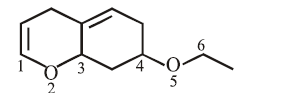
The total number of optically active compounds formed in the following reaction is:
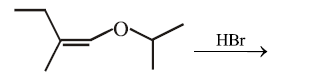
On the treatment of the following compound with a strong acid, the most susceptible site for bond cleavage is:
.webp)
Two compounds I and II are eluted by column chromatography (adsorption of I > II). Which one of the following is a correct statement?
Login to view the detailed solution.
When 2-butyne is treated with H$$_2$$/Lindlar's catalyst, compound X is produced as the major product and when treated with Na/liq. NH$$_3$$ it produces Y as the major product. Which of the following statements is correct?
Login to view the detailed solution.
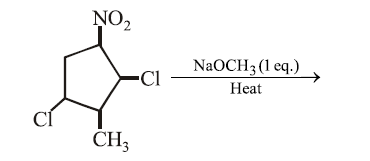
The major product formed in the following reaction is:

Biochemical oxygen demand (BOD) value can be a measure of water pollution caused by the organic matter. Which of the following statements is correct?
All of the following share the same crystal structure except:
Two 5 molal solutions are prepared by dissolving a non-electrolyte, non-volatile solute separately in the solvents X and Y. The molecular weights of the solvents are M$$_X$$ and M$$_Y$$, respectively where M$$_X$$ = $$\frac{3}{4}$$ M$$_Y$$. The relative lowering of vapour pressure of the solution in X is "m" times that of the solution in Y. Given that the number of moles of solute is very small in comparison to that of solvent, the value of "m" is:
Login to view the detailed solution.
_1.webp)
For a first order reaction, A $$\rightarrow$$ P, t$$_{1/2}$$ (half-life) is 10 days. The time required for $$\frac{1}{4}$$th conversion of A (in days) is: (ln 2 = 0.693, ln 3 = 1.1)
Login to view the detailed solution.
If x gram of gas is adsorbed by m gram of adsorbent at pressure P the plot of log $$\frac{x}{m}$$ versus log P is linear. The slope of the plot is: (m and k are constants and n > 1)
Login to view the detailed solution.
In the leaching method, bauxite ore is digested with a concentrated solution of NaOH that produces 'X'. When CO$$_2$$ gas is passed through the aqueous solution of 'X', a hydrated compound 'Y' is precipitated. 'X' and 'Y' respectively are:
Login to view the detailed solution.
In XeO$$_3$$ F$$_2$$, the number of bond pair(s), $$\pi$$-bond(s) and lone pair(s) on Xe atom respectively are:
Login to view the detailed solution.
The number of P - O bonds in P$$_4$$O$$_6$$ is:
Login to view the detailed solution.
The correct order of spin-only magnetic moments among the following is: (Atomic number: Mn = 25, Co = 27, Ni = 28, Zn = 30)
Login to view the detailed solution.
The total number of possible isomers for square planar [Pt(Cl)(NO$$_2$$)(NO$$_3$$)(SCN)]$$^{2-}$$ is:
Login to view the detailed solution.
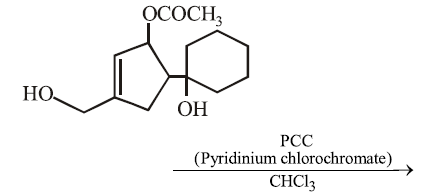
The major product formed in the following reaction is:
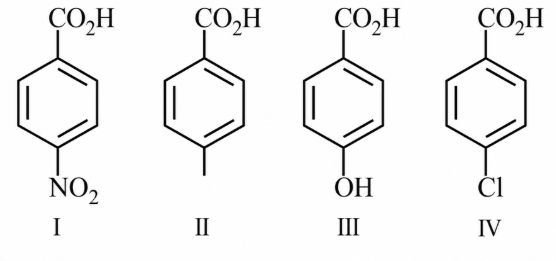
The increasing order of the acidity of the following carboxylic acids is:
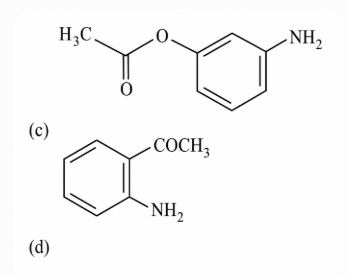
The increasing order of diazotisation of the following compounds is:
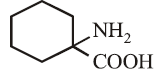
(a)
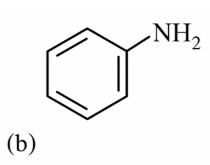
Which of the following statements is not true?
The dipeptide, Gln-Gly, on treatment with CH$$_3$$COCl followed by aqueous work up gives:
Educational materials for JEE preparation
 Share
Share