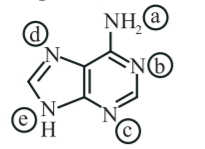
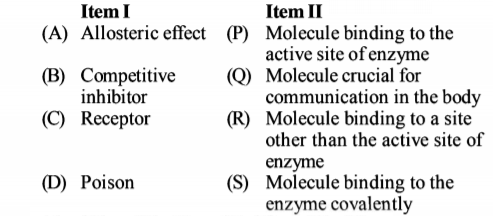
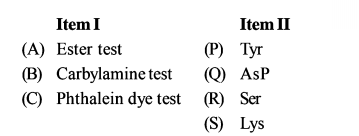
For the following questions answer them individually
25 mL of the given HCl solution requires 30 mL of 0.1M sodium carbonate solution. What is the volume of this HCl solution required to titrate 30 mL of 0.2M aqueous NaOH solution?
The de Broglie wavelength $$(\lambda)$$ associated with a photoelectron varies with the frequency $$(\nu)$$ of the incident radiation as, [$$\nu_0$$ is threshold frequency]:
The correct option with respect to the Pauling electronegativity values of the elements is:
The reaction $$MgO(s) + C(s) \to Mg(s) + CO(g)$$, for which $$\Delta H° = +491.1$$ kJ mol$$^{-1}$$ and $$\Delta S° = 198.0$$ JK$$^{-1}$$ mol$$^{-1}$$ is not feasible at 298 K. Temperature above which reaction will be feasible is
The standard reaction Gibbs energy for a chemical reaction at an absolute temperature T is given by $$\Delta G° = A - BT$$ where A and B are non-zero constants. Which of the following is true about this reaction?
For the equilibrium $$2H_2O \rightleftharpoons H_3O^+ + OH^-$$; the value of $$\Delta G°$$ at 298 K is approximately:
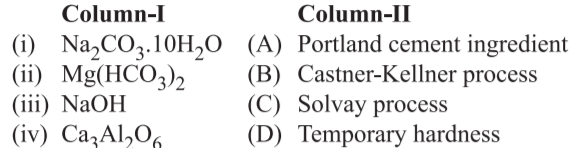
Match the following items in column I with the corresponding items in column II.
The hydride that is NOT electron deficient is:
The relative stability of +1 oxidation state of group 13 elements follows the order
Which of the following compounds reacts with ethylmagnesium bromide and also decolourizes bromine water solution?
Which of the following compounds will produce a precipitate with $$AgNO_3$$?
Taj Mahal is being slowly disfigured and discoloured. This is primarily due to
The higher concentration of which gas in air can cause stiffness of flower buds?
The radius of the largest sphere which fits properly at the centre of the edge of a body centred cubic unit cell is: (Edge length is represented by 'a')
$$K_2HgI_4$$ is 40% ionised in aqueous solution. The value of its van't Hoff factor (i) is:
Given the equilibrium constant: $$K_C$$ of the reaction: $$Cu(s) + 2Ag^+(aq) \to Cu^{2+}(aq) + 2Ag(s)$$ is $$10 \times 10^{15}$$. Calculate the $$E°_{cell}$$ of this reaction at 298 K. [$$2.303 \frac{RT}{F}$$ at 298 K = 0.059 V]
The reaction $$2X \to B$$ is a zeroth order reaction. If the initial concentration of X is 0.2M, the half-life is 6 h. When the initial concentration of X is 0.5M, the time required to reach its final concentration of 0.2M will be
Among the colloids cheese (C), milk (M) and smoke (S), the correct combination of the dispersed phase and dispersion medium, respectively is:
The reaction that does NOT define calcination is:
$$A \xrightarrow{4KOH, O_2} 2B_{(Green)} + 2H_2O$$; $$B \xrightarrow{4HCl} 2C_{(Purple)} + MnO_2 + 2H_2O$$; $$2C \xrightarrow{H_2O, KI} 2A + KOH + D$$. In the above sequence of reactions, A and D, respectively, are:
The coordination number of Th in $$K_4[Th(C_2O_4)_4(H_2O)_2]$$ is: ($$C_2O_4^{2-}$$ = oxalato)
The number of bridging CO ligand(s) and Co-Co bond(s) in $$Co_2(CO)_8$$, respectively are:
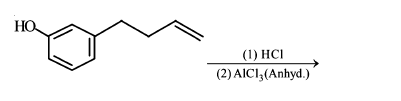
The major product of the following reaction is:
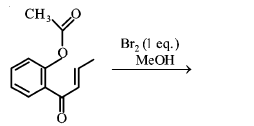
The major product obtained in the following conversion is:
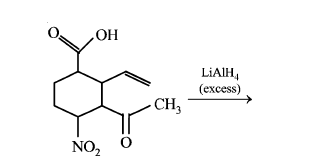
The major product obtained in the following reaction is:
In the following compound, the favourable site/s for protonation is/are:
A compound 'X' on treatment with Br$$_2$$/NaOH, provided $$C_3H_9N$$, which gives positive carbylamine test. Compound X' is:
The homopolymer formed from 4-hydroxy-butanoic acids is:
The correct match between Item I and Item II is: