NTA JEE Main 11th January 2019 Shift 1
For the following questions answer them individually
NTA JEE Main 11th January 2019 Shift 1 - Question 21
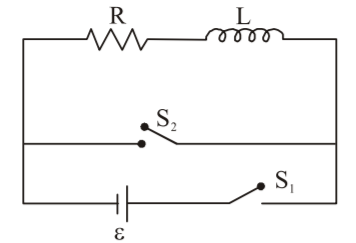
In the circuit shown, the switch $$S_1$$ is closed at time $$t = 0$$ and the switch $$S_2$$ is kept open. At some later time $$(t_0)$$, the switch $$S_1$$ is opened and $$S_2$$ is closed. The behaviour of the current I as a function of time t is given by:
NTA JEE Main 11th January 2019 Shift 1 - Question 22
An electromagnetic wave of intensity $$50 \text{ Wm}^{-2}$$ enters in a medium of refractive index 'n' without any loss. The ratio of the magnitudes of electric fields, and the ratio of the magnitudes of magnetic fields of the wave before and after entering into the medium are respectively, given by:
NTA JEE Main 11th January 2019 Shift 1 - Question 23
An object is at a distance of 20 m from a convex lens of focal length 0.3 m. The lens forms an image of the object. If the object moves away from the lens at a speed of 5 m/s the speed and direction of the image will be

NTA JEE Main 11th January 2019 Shift 1 - Question 24
The variation of refractive index of a crown glass thin prism with wavelength of the incident light is shown. Which of the following graphs is the correct one, if $$D_m$$ is the angle of minimum deviation?
NTA JEE Main 11th January 2019 Shift 1 - Question 25
In a Young's double slit experiment, the path difference, at a certain point on the screen, between two interfering waves is $$\dfrac{1}{8}$$ th of wavelength. The ratio of the intensity at this point to that at the centre of a bright fringe is close to:
NTA JEE Main 11th January 2019 Shift 1 - Question 26
If the deBroglie wavelength of an electron is equal to $$10^{-3}$$ times the wavelength of a photon of frequency $$6 \times 10^{14}$$ Hz, then the speed of electron is equal to: (Speed of light $$= 3 \times 10^8$$ m/s, Planck's constant $$= 6.63 \times 10^{-34}$$ J.s, Mass of electron $$= 9.1 \times 10^{-31}$$ kg)
NTA JEE Main 11th January 2019 Shift 1 - Question 27
A hydrogen atom, initially in the ground state is excited by absorbing a photon of wavelength 980 $$\widetilde{A}$$. The radius of the atom in the excited state, in terms of Bohr radius $$a_0$$, will be:
NTA JEE Main 11th January 2019 Shift 1 - Question 28
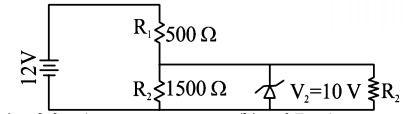
In the given circuit the current through Zener Diode is close to:
NTA JEE Main 11th January 2019 Shift 1 - Question 29
An amplitude modulated signal is given by $$V(t) = 10[1 + 0.3 \cos(2.2 \times 10^4 t)] \sin(5.5 \times 10^5 t)$$. Here t is in seconds. The sideband frequencies (in kHz) are, [Given $$\pi = 22/7$$]
NTA JEE Main 11th January 2019 Shift 1 - Question 30
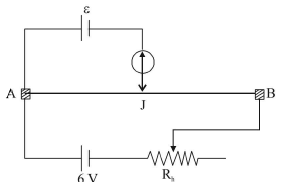
The resistance of the meter bridge AB in given figure is $$4\Omega$$. With a cell of emf $$\varepsilon = 0.5$$ V and rheostat resistance $$R_h = 2\Omega$$ the null point is obtained at some point J. When the cell is replaced by another one of emf $$\varepsilon = \varepsilon_2$$ the same null point J is found for $$R_h = 6\Omega$$. The emf $$\varepsilon_2$$ is: