NTA JEE Main 11th April 2015 Online
For the following questions answer them individually
NTA JEE Main 11th April 2015 Online - Question 11
Using equipartition of energy, the specific heat (in J kg$$^{-1}$$ K$$^{-1}$$) of Aluminium at high temperature can be estimated to be (atomic weight of Aluminium = 27)
NTA JEE Main 11th April 2015 Online - Question 12
A pendulum with the time period of 1 s is losing energy due to damping. At a certain time, its energy is 45 J. If after completing 15 oscillations its energy has become 15 J, then its damping constant (in s$$^{-1}$$) will be
NTA JEE Main 11th April 2015 Online - Question 13
A cylindrical block of wood (density = 650 kg m$$^{-3}$$), of base area 30 cm$$^2$$ and height 54 cm, floats in a liquid of density 900 kg m$$^{-3}$$. The block is depressed slightly and then released. The time period of the resulting oscillations of the block would be equal to that of a simple pendulum of length (nearly):

NTA JEE Main 11th April 2015 Online - Question 14
A source of sound emits sound waves at frequency $$f_0$$. It is moving towards an observer with fixed speed $$v_s$$ $$(v_s < v)$$, where $$v$$ is the speed of sound in air. If the observer were to move towards the source with speed $$v_0$$, one of the following two graphs (A and B) will give the correct variation of the frequency $$f$$ heard by the observer as $$v_0$$ is changed.
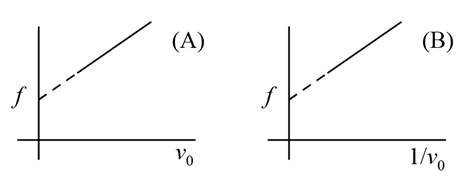
The variation of $$f$$ with $$v_0$$ is given correctly by:
NTA JEE Main 11th April 2015 Online - Question 15
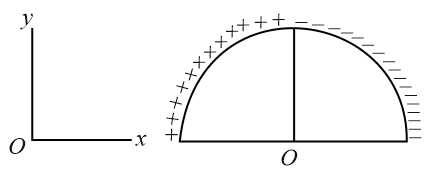
A wire of length $$L = 20$$ cm is bent into a semi-circular arc and the two equal halves of the arc are uniformly charged with charges $$+Q$$ and $$-Q$$ as shown in the figure. The magnitude of the charge on each half is $$|Q| = 10^3\varepsilon_0$$, where $$\varepsilon_0$$ is the permittivity of free space. The net electric field at the centre $$O$$ is
NTA JEE Main 11th April 2015 Online - Question 16
An electric field $$\vec{E} = \left(25\hat{i} + 30\hat{j}\right)$$ N C$$^{-1}$$ exists in a region of space. If the potential at the origin is taken to be zero then the potential at $$x = 2$$ m, $$y = 2$$ m is:
NTA JEE Main 11th April 2015 Online - Question 17
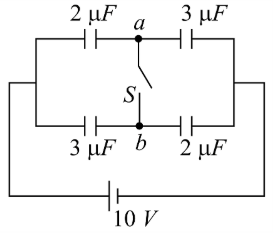
In the figure is shown a system of four capacitors connected across a 10 V battery. The charge that will flow from switch S when it is closed is:
NTA JEE Main 11th April 2015 Online - Question 18
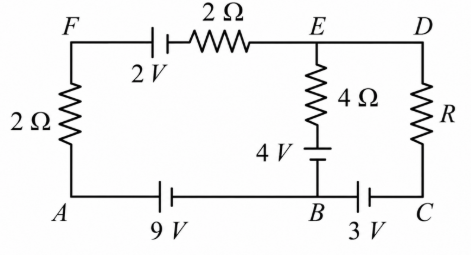
In the electric network shown, when no current flows through the 4 $$\Omega$$ resistor in the arm EB, the potential difference between the points A and D will be:
NTA JEE Main 11th April 2015 Online - Question 19
A short bar magnet is placed in the magnetic meridian of the earth with North Pole pointing north. Neutral points are found at a distance of 30 cm from the magnet on the East-West line, drawn through the middle point of the magnet. The magnetic moment of the magnet in Am$$^2$$ is close to: (Given $$\frac{\mu_0}{4\pi} = 10^{-7}$$ in SI units and $$B_H$$ = Horizontal component of earth's magnetic field = $$3.6 \times 10^{-5}$$ Tesla.)
NTA JEE Main 11th April 2015 Online - Question 20
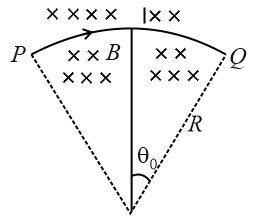
A wire carrying current $$I$$ is tied between points $$P$$ and $$Q$$ and is in the shape of a circular arc of radius $$R$$ due to a uniform magnetic field $$B$$ (perpendicular to the plane of the paper, as shown in the figure) in the vicinity of the wire. If the wire subtends an angle $$2\theta_0$$ at the center of the circle (of which it forms an arch) then the tension in the wire is: