NTA JEE Main 10th April 2023 Shift 1
For the following questions answer them individually
NTA JEE Main 10th April 2023 Shift 1 - Question 1
A physical quantity $$P$$ is given as $$P = \frac{a^2 b^3}{c\sqrt{d}}$$. The percentage error in the measurement of $$a$$, $$b$$, $$c$$ and $$d$$ are 1%, 2%, 3% and 4% respectively. The percentage error in the measurement of quantity $$P$$ will be
NTA JEE Main 10th April 2023 Shift 1 - Question 2
The position-time graphs for two students A and B returning from the school to their homes are shown in figure.
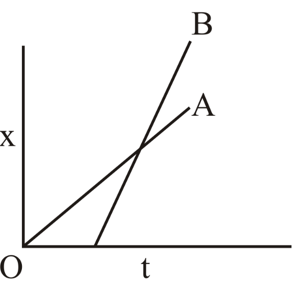
(A) A lives closer to the school
(B) B lives closer to the school
(C) A takes lesser time to reach home
(D) A travels faster than B
(E) B travels faster than A
Choose the correct answer from the options given below
NTA JEE Main 10th April 2023 Shift 1 - Question 3
The range of the projectile projected at an angle of 15$$^\circ$$ with horizontal is 50 m. If the projectile is projected with same velocity at an angle of 45$$^\circ$$ with horizontal, then its range will be

NTA JEE Main 10th April 2023 Shift 1 - Question 4
A particle of mass $$m$$ moving with velocity $$v$$ collides with a stationary particle of mass $$2m$$. After collision, they stick together and continue to move together with velocity
NTA JEE Main 10th April 2023 Shift 1 - Question 5
Two satellites of masses m and 3m revolve around the earth in circular orbits of radii r & 3r respectively. The ratio of orbital speeds of the satellites respectively is
NTA JEE Main 10th April 2023 Shift 1 - Question 6
Assuming the earth to be a sphere of uniform mass density, the weight of a body at a depth $$d = \frac{R}{2}$$ from the surface of earth, if its weight on the surface of earth is 200 N, will be : (Given $$R$$ = radius of earth)
NTA JEE Main 10th April 2023 Shift 1 - Question 7
Given below are two statements:
Statement I: Pressure in a reservoir of water is same at all points at the same level of water.
Statement II: The pressure applied to enclosed water is transmitted in all directions equally.
In the light of the above statements, choose the correct answer from the options given below:
NTA JEE Main 10th April 2023 Shift 1 - Question 8
Consider two containers A and B containing monoatomic gases at the same Pressure $$P$$, Volume $$V$$ and Temperature $$T$$. The gas in A is compressed isothermally to $$\frac{1}{8}$$ of its original volume while the gas in B is compressed adiabatically to $$\frac{1}{8}$$ of its original volume. The ratio of final pressure of gas in B to that of gas in A is
NTA JEE Main 10th April 2023 Shift 1 - Question 9
Match List I with List II:
| List I | List II | ||
|---|---|---|---|
| (A) | 3 Translational degrees of freedom | (I) | Monoatomic gases |
| (B) | 3 Translational, 2 rotational degrees of freedom | (II) | Polyatomic gases |
| (C) | 3 Translational, 2 rotational and 1 vibrational degrees of freedom | (III) | Rigid diatomic gases |
| (D) | 3 Translational, 3 rotational and more than one vibrational degrees of freedom | (IV) | Nonrigid diatomic gases |
Choose the correct answer from the options below:
NTA JEE Main 10th April 2023 Shift 1 - Question 10
A particle executes S.H.M. of amplitude $$A$$ along $$x$$-axis. At $$t = 0$$, the position of the particle is $$x = \frac{A}{2}$$ and it moves along positive $$x$$-axis. The displacement of particle in time $$t$$ is $$x = A\sin(\omega t + \delta)$$, then the value $$\delta$$ will be