NTA JEE Main 1st February 2023 Shift 1
For the following questions answer them individually
NTA JEE Main 1st February 2023 Shift 1 - Question 11
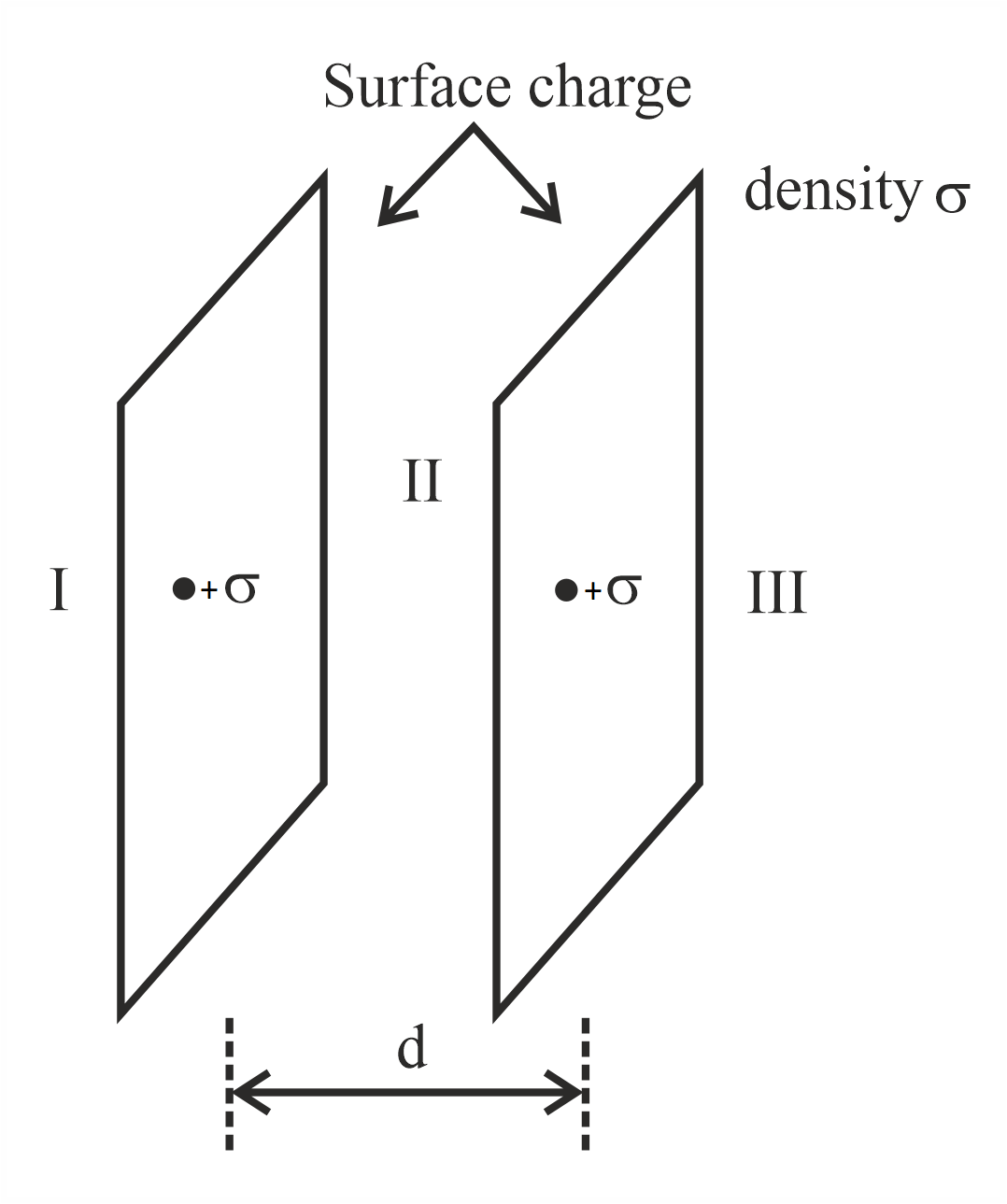
Let $$\sigma$$ be the uniform surface charge density of two infinite thin plane sheets shown in figure. Then the electric fields in three different region $$E_I$$, $$E_{II}$$ and $$E_{III}$$
NTA JEE Main 1st February 2023 Shift 1 - Question 12
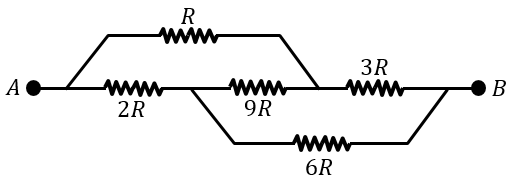
The equivalent resistance between A and B of the network shown in figure:
NTA JEE Main 1st February 2023 Shift 1 - Question 13
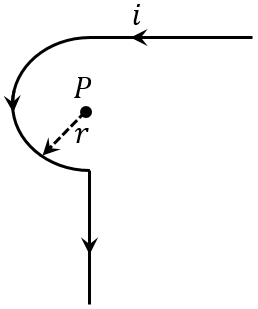
Find the magnetic field at the point P in figure. The curved portion is a semicircle connected to two long straight wires.

NTA JEE Main 1st February 2023 Shift 1 - Question 14
Match the List-I with List-II.
A. AC generator I. Presence of both L and C
B. Transformer II. Electromagnetic Induction
C. Resonance phenomenon to occur III. Quality factor
D. Sharpness of resonance IV. Mutual Inductance
NTA JEE Main 1st February 2023 Shift 1 - Question 15
Match the List-I with List-II:
A. Microwaves I. Radioactive decay of the nucleus
B. Gamma rays II. Rapid acceleration and deceleration of electron in aerials
C. Radio waves III. Inner shell electrons
D. X-rays IV. Klystron valve
NTA JEE Main 1st February 2023 Shift 1 - Question 16
'$$n$$' polarizing sheets are arranged such that each makes an angle 45° with the proceeding sheet. An unpolarized light of intensity $$I$$ is incident into this arrangement. The output intensity is found to be $$\frac{I}{64}$$. The value of $$n$$ will be:
NTA JEE Main 1st February 2023 Shift 1 - Question 17
A proton moving with one tenth of velocity of light has a certain de Broglie wavelength of $$\lambda$$. An alpha particle having certain kinetic energy has the same de-Broglie wavelength $$\lambda$$. The ratio of kinetic energy of proton and that of alpha particle is:
NTA JEE Main 1st February 2023 Shift 1 - Question 18
The mass of proton, neutron and helium nucleus are respectively 1.0073 u, 1.0087 u and 4.0015u. The binding energy of helium nucleus is:
NTA JEE Main 1st February 2023 Shift 1 - Question 19
Match the List I with List II
A. Intrinsic Semiconductor I. Fermi-level near valence band
B. n-type semiconductor II. Fermi-level at middle of valence and conduction band
C. p-type semiconductor III. Fermi-level near conduction band
D. Metals IV. Fermi-level inside conduction band
NTA JEE Main 1st February 2023 Shift 1 - Question 20
Which of the following frequencies does not belong to FM broadcast.