91- 6303239042
 IPMAT WhatsApp Group


IPMAT Quant Syllabus 2027
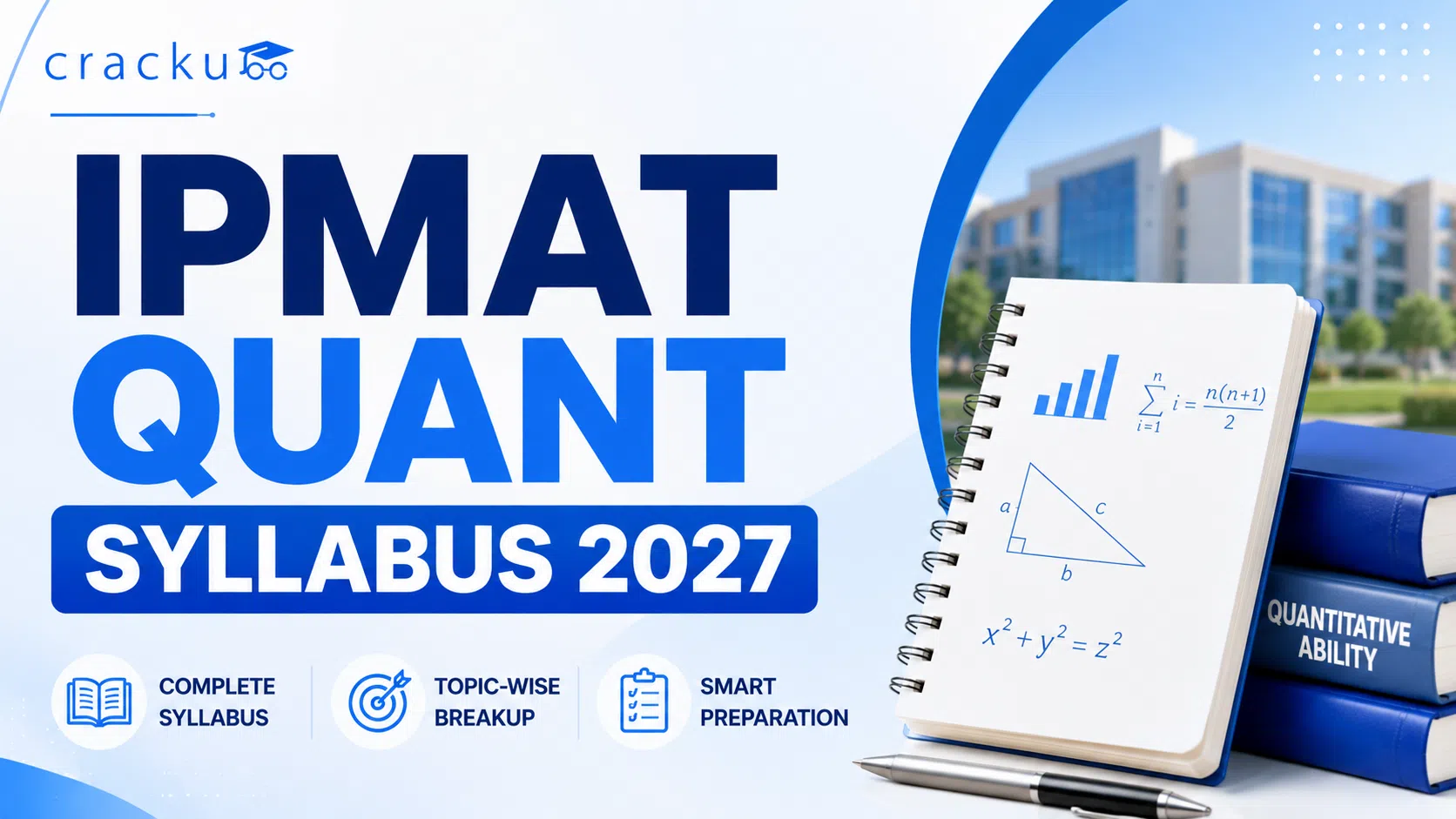
The IPMAT Quant Syllabus 2027 tests mathematical capability and logical capacity through Class 9 to 12 Mathematics. Core assessment areas include Number System, Algebra, Geometry, Arithmetic, Modern Math concepts, and Data Interpretation. Sectional navigation rules depend entirely on the specific institute. IIM Indore strictly mandates a prearranged section order, while IIM Rohtak allows free movement.
Higher mathematics in Class 11 or 12 remains optional for IIM Indore and IIM Rohtak. Other institutes enforce different rules. IIM Shillong and IIM Amritsar strictly require Class 12 mathematics to qualify for their programs. The IPMAT syllabus deliberately tests cognitive flexibility to challenge students from diverse academic backgrounds. Both tested sections demand rapid operational speed alongside deep logical reasoning.
IPMAT Quant Syllabus for Indore
The IPMAT Quant Syllabus for Indore spans from fundamental school arithmetic to advanced Class 11 and 12 mathematics. Candidates face a two part structure featuring 30 multiple choice questions in 40 minutes and 15 short answer questions in 40 minutes. The multiple choice section strictly enforces a penalty of 1 mark for every wrong answer.
Short answer questions do not carry any negative marking. Candidates calculate true mathematical derivations because there are no multiple choice options available to reverse engineer. This format demands high precision since guessing is completely eliminated. Candidates rely entirely on accurate calculation methodology to secure these specific marks.
Topic | IPMAT Syllabus: Sub-Topics | ||
Number System | Successive Division | Divisibility | Finding Unit Digit |
Factorial | HCF & LCM | Surds & Indices | |
Simplification | Properties of a Number | Remainder | |
Concept of Factor | |||
Algebra | Inequalities | Algebraic Formulae | Logarithm |
Quadratic Equations | Linear Equations | Functions & Graphs | |
Geometry | Coordinate Geometry | Circle | Basics of Geometry |
Triangles | Quadrilaterals | Polygons | |
Lines | Angles | Mensuration | |
Height & Distance | |||
Arithmetic Problems | Profit Loss & Discount | Average | Problems on Age |
Percentage | Partnership | Boats & Streams | |
Ratio & Proportion | Time & Work | Mixture & Allegations | |
Time, Speed & Distance | – | ||
Modern Maths | Set theory | Integration & Differentiation | Permutation & Combination |
Determinants | Probability | Sequence & Series | |
Matrix | Data Interpretation | Vectors | |
IPMAT Quant Syllabus for Rohtak
The IPMAT Quant Syllabus for Rohtak relies entirely on high school mathematics. Precision and calculation speed matter significantly more than advanced mathematical theory. Candidates tackle 40 multiple choice questions with a recommended duration of 40 minutes.
Each question carries a 4 marks reward and a 1 mark penalty for incorrect responses. Fast readers frequently finish the Verbal section early and transfer that saved time to the Quantitative section. Applying this cross sectional time arbitrage is completely legal. It works flawlessly because the official exam structure imposes no strict sectional time limits.
Quantitative Aptitude Syllabus | |||
Number systems | Common graphs & charts | Data Interpretation | Mixtures and Allegations |
Distance, Time, and Work | Averages | Quantitative reasoning | Geometry |
Profit & Loss | Simple Equations | Percentages | Quadratic Equations |
Binomial Theorem | Mensuration | Permutation & Combination | Ratio & Proportion |
Trigonometry | Set Theory | Problems on Ages | Logarithms |
IPMAT Indore Quant topics with weightage
IPMAT Indore Quant topics with weightage distribute across a total of 45 questions split into multiple choice and short answer formats. Arithmetic holds the absolute highest priority by securing between 22 to 33% of the entire quantitative section. Modern Math and Algebra closely follow with highly significant question counts every single year.
General category candidates required 28 marks in the short answer section and 27 marks in the multiple choice section to clear the 2026 official cutoff. The short answer cutoff jumped to 28 marks in 2026. This increase happened because candidates freely attempt all 15 questions without any negative marking penalty. True accuracy on Algebra and higher math ultimately decides who clears the examination.
Topic Category | Expected Questions | Overall Weightage |
Arithmetic | 10 to 15 | 22 to 33% |
Algebra | 8 to 12 | 18 to 27% |
Modern Math | 7 to 10 | 16 to 22% |
Data Interpretation | 5 to 10 | 11 to 22% |
Geometry and Mensuration | 5 to 8 | 11 to 18% |
Number System | 5 to 7 | 11 to 16% |
IPMAT Rohtak Quant topics with weightage
Arithmetic heavily dominates the IPMAT Rohtak Quant topics with weightage by making up nearly half of the entire 40 question examination block. The IPMAT 2026 exam analysis revealed Percentages and Boats and Streams as the heaviest testing areas, featuring seven and five questions respectively.
Examiners include niche arithmetic applications like Banker's Discount to separate top percentiles. Approximately five miscellaneous arithmetic questions focused specifically on these obscure concepts in the recent 2026 examination. Broad topic coverage dictates final scores because examiners pull calculations from the deepest corners of the high school syllabus.
Topic Category | Expected Questions | Overall Weightage |
Arithmetic | 15 to 20 | 37 to 50% |
Algebra | 5 to 8 | 12 to 20% |
Modern Math | 5 to 7 | 12 to 18% |
Data Interpretation | 5 to 6 | 11 to 13% |
Geometry and Mensuration | 3 to 5 | 7 to 12% |
Number System | 3 to 5 | 7 to 12% |
Read More: IPMAT Formula PDF, Download Quant Formula Sheet PDF
How to Prepare for IPMAT Quant 2027?
Mastering the IPMAT Quant Syllabus 2027 requires a structured twelve month study cycle. This extended timeline is the precise methodology for how to prepare for IPMAT Quant 2027 effectively. Daily Quantitative Aptitude practice sessions of exactly one and a half hours build foundational speed. Consistent calculation drills build the massive mathematical stamina required for the demanding final test day.
Analytical error logging transforms standard mock analysis into a highly targeted mathematical improvement tool. Test takers separate every single mock error into conceptual mistakes, calculation slips, or time management failures. Categorizing errors dictates the exact recovery step. This precise logging dictates whether to initiate immediate textbook revision or begin strict timer practice.
Study Phase | Core Focus | Actions Required |
Phase 1 | Concept Building | Study NCERT Class 9 to 12 Arithmetic and basic Algebra. |
Phase 2 | Speed Mastery | Solve 30 topic-specific questions like Time Speed, Distance. |
Phase 3 | Sectional Mocks | Take timed 40-minute sectional tests for exam stamina. |
Phase 4 | Optimization | Solve 20 full-length mocks using the two-pass strategy. |
Read More: IPMAT Preparation Strategy, Section-Wise Tips for Exam
Preparation Tips for IPMAT Quants
Actionable preparation tips for IPMAT Quants shift the study focus from slow conceptual learning to rapid exam execution over time. Building a robust mathematical foundation takes absolute priority over solving speed initially. Taking early mocks without checking final scores eliminates initial testing anxiety. A safe testing environment lets candidates simply absorb the official paper format before actual pressure builds.
(Phase -1) Conceptual Building and Baseline Testing:
- Concept clarity focus: Spend up to 15 minutes unraveling a single problem to fully grasp the fundamental logic.
- Daily formula documentation: Record squares up to 30, cubes up to 20, and key geometry theorems daily.
- Baseline mock schedule: Take exactly one full mock exam every three weeks to map initial strengths.
- Early testing volume: Complete approximately eight initial mocks without worrying about the raw numerical scores.
(Phase -2) Application and Speed Strategy:
- Sectional quiz integration: Introduce strict time limits to translate conceptual clarity into actual exam stamina.
- Reverse option engineering: Plug multiple choice options directly back into core equations for rapid Algebra solutions.
- Intermediate testing frequency: Step up the preparation schedule to exactly one mock exam every two weeks.
- Question skipping threshold: Abandon any problem that lacks a clear solution path after exactly 60 seconds.
(Phase -3) Exam Simulation and Peak Testing:
- Two pass traversal: Solve direct arithmetic first and tackle multi layered equations during the second pass.
- Final testing frequency: Complete the IPMAT mock test every single week to perfect test temperament.
- Late stage volume: Finish exactly eight final mocks focusing entirely on fixing recurring conceptual errors.
IPMAT Quant Syllabus 2027: Conclusion
The IPMAT Quant Syllabus 2027 plays a major role in deciding the final performance of candidates appearing for IIM Indore, IIM Rohtak, and other IPM entrance exams. Since the syllabus covers Arithmetic, Algebra, Geometry, Number System, Modern Maths, Mensuration, and Data Interpretation, students must focus on both concept clarity and calculation speed. Understanding the difference between IPMAT Indore Quant syllabus and IPMAT Rohtak Quant syllabus is also important because the question pattern, difficulty level, marking scheme, and sectional rules are different for both exams.
To prepare effectively for IPMAT Quant 2027, candidates should follow a structured study plan with daily practice, formula revision, timed sectional tests, and regular mock analysis. Arithmetic and Algebra should be given high priority because they carry strong weightage in both Indore and Rohtak exams. A smart preparation strategy, proper error tracking, and consistent mock practice can help students improve accuracy, manage time better, and perform confidently in the IPMAT 2027 exam.