91- 6303239042
Which of the following should not be subsidised over the years ?
Sign in
Please select an account to continue using cracku.in
↓ →
Governments looking for easy popularity have frequently been tempted into announcing giveaways of all sorts; free electricity, virtually free water, subsidized food, cloth at half price, and so on. The subsidy culture has gone to extremes. The richest farmers in the country get subsidized fertilizers. University education, typically accessed by the wealthier sections, is charged at a fraction of cost. Postal services are subsidized, and so are railway services. Bus fares cannot be raised to economical levels because there will be violent protest, so bus travel is subsidized too. In the past, price control on a variety of items, from steel to cement, meant that industrial consumer of these items got them at less than actual cost, while the losses of the public sector companies that produced them were borne by the taxpayer! A study done a few years ago, came to the conclusion that subsidies in the Indian economy total as much as 14.5 per cent of gross domestic product. At today's level, that would work out to about 1,50,000 crore. And who pay the bill? The theoryand the Political fiction on the basis of I which it is sold to unsuspecting votersis that subsidies go the poor. and are paid for by the rich. The fact is that most subsidies go the 'rich' (defined in the Indian context as those who are above the poverty line), and much of the tab goes indirectly to the poor. Because the hefty subsidy bill results in fiscal deficits, which in turn push up rates of inflationwhich, as everyone knows, hits the poor the hardest of all. That is why taxmen call inflation the most regressive form of taxation. The entire subsidy system is built on the thesis that people cannot help themselves, therefore governments must do so. That people cannot afford to pay for variety of goods and services, and therefore the government must step in. This thesis has been applied not just in the poor countries but in the rich ones as well; hence the birth of the welfare state in the west, and an almost Utopian social security system; free medical care, food aid, old age security, et.al. But with the passage of time, most of the wealthy nations have discovered that their economies cannot sustain this social safety net, which in fact reduces the desire among people to pay their own way, and takes away some of the incentive to work, in short, the bill was unaffordable, and their societies were simply not willing to pay. To the regret of many, but because of the laws of economies are harsh, most Western societies have been busy pruning the welfare bill. In India, the lessons of this experience over several decades, and in many countriesdo not seem to have been learnt. Or they are simply ignored in the pursuit of immediate votes. People who are promised cheap food or clothing do not in most cases look beyond the gift horsesto the question of who picks up the tab. The uproar over higher petrol, diesel and cooking gas prices ignored this basic question; if the user of cooking gas does not want to pay for its cost, who should pay? Diesel in the country is subsidised, and if the user of cooking gas does not want to pay for its full cost, who does he or she think should pay the balance of the cost? It is a simple question, nevertheless if remains unasked. The Deva Gowda government has shown some courage in biting the bullet when it comes to the price of petroleum products. But it has been bitten by much bigger subsidy bug. It wants to offer food at half its cost to everyone below the poverty line, supposedly estimated at some 380 million people. What will be the cost? And of course, who will pick up the tab? The Andhra Pradesh Government has been bankrupted by selling rice as 2 per kg. Should the Central Government be bankrupted too, before facing up to the question of what is affordable and what is not? Already, India is perennially short of power because the subsidy on electricity has bankrupted most electricity boards, and made private investment wary unless it gets all manner of state guarantees. Delhi's subsidised bus fares have bankrupted the Delhi Transport Corporation, whose buses have slowly disappeared from the capital's streets. It is easy to be soft and sentimental, by looking at programmes that will be popular. After all, who does not like a free lunch? But the evidence is surely mounting that the lunch isn't free at all. Somebody is paying the bill. And if you want to know who, take at the country's poor economic performance over the years.
Which of the following should not be subsidised over the years ?
The statement that 'subsidies are paid by the rich and go to the poor' is
Loading solution...
Why do you think that the author calls the Western social security system Utopian ?
Loading solution...
It can be inferred from the passage that the author :
Loading solution...
Which of the following is not a victim of extreme subsidies ?
Loading solution...
Which of the following is not true in the context of the passage ?
Loading solution...
A suitable title to the passage would be :
Loading solution...
Rearrange the following six sentences (A), (B), (C), (D), (E) and (F) in the proper sequence to form a meaningful paragraph and then
answer the questions given below.
A. It is the only country in the world that is carbon negative, which means it
produces more oxygen than it consumes.
B. Bhutan, sandwiched between the two most populous nations on Earth,
suffers for their sins.
C. So far, so good. But then, two things happened.
D. Carbon sinks, 70% forest cover, powered almost entirely by mountain
streams—Bhutan is a poster child for green living.
E. Glaciers are beginning to melt, flash floods and heavy rains—and even droughts— are common, and temperatures are climbing.
F. One, India and China got richer.
Which of the following should be the FIRST sentence of the given paragraph ?
Loading solution...
Which of the following should be the THIRD sentence of the given paragraph ?
Loading solution...
Which of the following should be the LAST sentence of the given paragraph ?
Loading solution...
Which of the following should be the FOURTH sentence of the given paragraph ?
Loading solution...
Which of the following should be the SECOND sentence of the given paragraph ?
Loading solution...
In the following questions, you have a brief passage. In the passage, some of the words have been left out. First read the passage over and try to understand what it is about. Then fill in the blanks with the help of the
alternatives given. Big ideas come from tackling ...(13)... problems. When one is confronted with an overwhelming task, it's pieces. Business jargon is full of phrases about that, like "pilot projects" and "lowhanging fruit." They have their place, but in the repertory of management ...(14)... they should share their place with bold approaches to big challenges. Much of today's most valuable management knowledge came from wrestling with such issues. The most complicated workplace in the middle of the last century was the automobile assembly plant. Drawn to its complexity where Peter F. Drucker, W. Edwards Deming, and Taiichi Ohno, among others. The work they and their disciples did, applied in industry after industry, is the basis of the best that we know about
operations, managing people, innovation, organizational design, and much more. The most complex workplaces are tertiary care hospitals. These vast ...(15)... employ tens of thousands of people who, under one roof, do everything from neurosurgery to laundry. Each patient – that is to say, each "job" — calls on a different set of people with a different constellation of ...(16)... even when the two patients have the same diagnosis, success may be ...(17)... differently. This is complexity of an order of magnitude greater than automobile assembly, and
anyone who ...(18)... hospitalized knows that management has thus far been unequal to the scope of task. The workers, managers, consultants, and scholars ...(19)... crack this nut will reshape industries and institutions just as ... (20)... as Drucker, Deming, and Ohno did.
Loading solution...
Loading solution...
Loading solution...
Loading solution...
Loading solution...
Loading solution...
Loading solution...
Loading solution...
Identify the error in the sentences given below, if there is no error, mark option e:
Loading solution...
Loading solution...
Loading solution...
Loading solution...

Loading solution...
Loading solution...
Loading solution...
Loading solution...
Loading solution...
Loading solution...
Study the table carefully and answer the given questions.
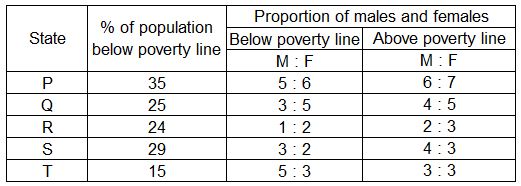
If the male population above poverty line for State R is 2.38 lakhs then what is the total population of R?
Loading solution...
What will be the number of females above poverty line in the State S if it is known that the population of State S is 7 million ?
Loading solution...
What is the male population above poverty line for State P if the female population below poverty line for State P is 2.1 million ?
Loading solution...
If the population of males below poverty line for State Q is 2.4 million and that for State T is 6 million, then what is the respective ratio of the total population of states Q and T ?
Loading solution...
Find the probability that a number from 1 to 300 is either divisible by 3 or 7?
Loading solution...
14 men can do a work in 18 days, 15 women can do a work in 24 days. If 14 men work for first three days and 10 women work after that for three days, find the part of work left after that?
Loading solution...
Perimeter of a rectangle is x and circumference of a circle is 8 more than the perimeter of the rectangle. Ratio of radius of circle and length of the rectangle is 1:2 and ratio of length and breadth of rectangle is 7:3. Find the length of the rectangle ?
Loading solution...
A invests on some scheme at 5% and B at 3% for two years. If the total sum invested by A and B is 4000 and the simple interest received by both is same then find the amount invested by A.
Loading solution...
Two trains crosses each other in 14 sec when they are moving in opposite direction, and when they are moving in same direction they crosses each other in 3 min 2 sec. Find the speed of the faster train by what percent more than the speed of the slower train ?
Loading solution...
What will come in place of the question mark (?) in the following number series ?
11, 20, 38, 74, ?
Loading solution...
15, 21, 38, 65, 101, ?
Loading solution...
24, 28, 19, 35, 10, ?
Loading solution...
7, 16, 45, 184, 915, ?
Loading solution...
12, 19, 35, 59, 90, ?
Loading solution...
Study the following table and answer the questions that follow. “Graph”

The incomes of companies X and Y in 2010 were in the ratio of 3 : 4 respectively. What was the respective ratio of their expenditures in 2010 ?
Loading solution...
If the expenditure of company Y in 2007 was ! 220 crores, what was its income in 2007 ?
Loading solution...
If the expenditures of companies X and Y in 2006 were equal and the total income of two companies in 2006 was Rs. 342 crores, what was the total profit of two companies together in 2006 ? (Profit = Income Expenditure)
Loading solution...
The expenditure of company X in the year 2008 was Rs. 200 crores and the income of company X in 2008 was the same as its expenditure in 2011. What is the income of Company X in 2011 ?
Loading solution...
If the incomes of two companies were equal in 2009, then what was the ratio of expenditure of Company X to that of Company Y in 2009 ?
Loading solution...
In each of these questions, two equations (I) and (II) are given. You have to solve both the equations and Give answer :
I. $$3x^2 - 22x + 7 = 0$$
II. $$y^2 - 15y + 56 = 0$$
Loading solution...
I. $$2x^{2} - 17x + 36 = 0$$
II. $$2y^{2} - 19y + 44 = 0$$
Loading solution...
I. $$x-\sqrt{169}=0$$
II. $$y^{2}-169=0$$
Loading solution...
I. $$3x^{2} + 20x + 25 = 0$$
II. $$3y^{2} + 14y + 8 =0$$
Loading solution...
I. $$3x^{2} + 5x + 2 = 0$$
II. $$3y^{2} + 18y + 24 = 0$$
Loading solution...
A seller marks the price 50% above the cost price and gives a 10% discount on an item. While selling, he cheats the customer by offering 20% less weight. What is the approximate value of the overall profit per cent?
Loading solution...
There are 81 litre pure milk in a container. One third of milk is replaced by water in the container. Again onethird of mixture is extracted and equal amount of water is added. What is the ratio of milk to water in the new mixture ?
Loading solution...
A is 2 years older than B while B is 3 years younger than C. The ratio of age of A, 6 years hence and B, 2 years ago is 5:3. What was age of C, 6 years ago ?
Loading solution...
A, B and C started a business with their investments in the ratio 1 : 2 : 4. After 6 months, A invested the half amount more as before and B invested same the amount as before while C withdrew 1/4th of his investment. Find the ratio of their profits at the end of the year.
Loading solution...
The average marks in Science subject of a class of 20 students is 68. If the marks of two students were misread as 48 and 65 of the actual marks 72 and 61 respectively, then what would be the correct average ?
Loading solution...
40% of 265 + 35% of 180 = 50% of ? + ?% of 80
Loading solution...
$$\sqrt{0.25}\times0.16 ~of ~157 =?$$
Loading solution...
$$\sqrt{?}+ 416$$ = (60% of 920) - 110
Loading solution...
(682% of 782)$$ \div$$856 = ?
Loading solution...
15.5% of 850 + 24.8% of 650 = ?
Loading solution...
The time taken by a boat to travel; `x' km upstream is twice the time taken by the same boat to travel `x' km downstream. If speed of the boat in still water is 12 km/h. what is the speed of current ? (in km/h)
Loading solution...
In these questions, relationship between different elements is shown in the statements. The statements are followed by conclusions. Study the conclusions based on the given statements and select the appropriate answer. Give answer :
a: If only conclusion II is true
b: If only conclusion If is true
c: If both conclusions I and II are true
d: If either conclusion I or II is true
e: If neither conclusion I nor II is true
Statements :
S ≤ L ≤ I = P ≥ E > R ; L > Q
Conclusions :
I. P ≥ S
II. I > R
Loading solution...
Statements :
G > R ≤ E = A ≤ T ≤ S ; D ≤ A ≤J
Conclusions :
I. T ≥ D
II. R > S
Loading solution...
Statements :
A ≥ B > C ≤ D ≤ E < F
Conclusions :
I. A ≥ E
II. C < F
Loading solution...
Statements :
G > R ≥ E = A ≤ T ≤ S ; D ≤ A ≤ J
Conclusions :
I. J > G
II. J = G
Loading solution...
Statements :
S ≤ E ≤ I = P ≥ E > R; L > Q
Conclusions:
I . L < R
II. E ≥ Q
Loading solution...
Study the following information carefully and answer the questions given below.
Eight persons — H, I, J, K, L, M, N and O — are standing in a straight line at equidistant. Some of them are facing north while others are facing south. M is standing third to the right to H. M is standing at one of the extreme ends. L is standing third to the left of H. The immediate neighbours of J. face north. N is not an immediate neighbour of H.The persons standing at the extreme ends face the same direction (both are facing either north or south). The immediate neighbours of H face, just opposite direction as that of M. The immediate neighbours of 0 face opposite direction with respect to each other.K is one of the immediate neighbours of L and is facing north. I is standing between J and M. Notmore than four persons are facing north.L is immediate right of K.
Who among the following is third to the left of N ?
Loading solution...
The immediate neighbours of L are :
Loading solution...
How many persons are standing exactly between I and 0 ?
Loading solution...
Four of the following five are alike in a certain way based on the above arrangement and hence form a group. Which of the following does not belong to that group ?
Loading solution...
Who among the following is exactly between L and J ?
Loading solution...
In each question below are given two/three statements followed by two conclusions numbered I and II. You have to take the given statements to be true even if they seem to be at variance with commonly known facts. Read all the conclusions and then decide which of the given conclusions logically follows from the given statements, disregarding commonly known facts. Give answer :
a: If only conclusion I follows.
b: If only conclusion II follows.
c: If either conclusion I or II follows.
d: If neither conclusion I nor II follows.
e: If both conclusions I and II follow.
Statements :
All circles are a triangle.
Some triangles is rectangles.
All rectangles are squares.
Conclusions :
I. All rectangles being triangles is a possibility.
II. All circles being squares is a possibility.
Loading solution...
Statements :
Some chairs are tables.
Some beds are tables.
No furniture is bed.
Conclusions :
I. All chairs being furniture is a possibility.
II. Some tables are not bed is a possibility.
Loading solution...
Statements :
All circles are a triangle.
Some triangles are rectangles.
All rectangles are squares.
Conclusions :
I. Some triangles are not rectangles.
II. No square is a circle.
Loading solution...
Statements :
All art are theatre.
Some art are dramas
Conclusions :
I. All dramas being theatre is a possibility.
II. Some dramas are theatre.
Loading solution...
Statements :
Some chairs are tables.
Some beds are tables.
No furniture is bed.
Conclusions :
I. Some tables are not furniture.
II. All tables being furniture is a possibility.
Loading solution...
Read the given information carefully and answer the given questions. B is 25 m south of A. C is 10 m east of B. D is 30 m north of C. E is 7 m east of D. X is 18 m south of E. M is 12 m south of X. C is 7 m west of M.
B is in which direction from Point D ?
Loading solution...
If Point W is 3 m to the north of A, then what is the distance between B and W ?
Loading solution...
What is the distance between B and M?
Loading solution...
Study the following information to answer the given questions. S, T, U, V, W, X, Y and Z are sitting in a straight line equidistant fromeach other (but not necessarily in the same order). Some of them are facing south while some are facing north. (Note : Facing the same direction means, if one is facing north then the other also faces north and viceversa. Facing the opposite directions means, if one is facing north then the other faces south and viceversa) S faces north. Only two people sit to the right of S. T sits third to the left of S. Only one person sits between T and X. X sits to the immediateright of W. Only one person sits between W and Z. Both the immediate neighbours of T face the same direction. U sits third to the left of X. T faces the opposite direction as S. Y does not sit at any of the extreme ends of the line. V faces the same direction as W. Both Y and U face the opposite direction of Z.
How many persons in the given arrangement are facing North ?
Loading solution...
Four of the following five are alike in a certain way, and so form a group. Which of the following does not belong to the group ?
Loading solution...
What is the position of X with respect to Z ?
Loading solution...
Who amongst the following sits exactly between Z and W ?
Loading solution...
Who is sitting second to the right of T ?
Loading solution...
Study the following information and answer the given questions.
• D is daughter of N. E is wife of N.
• G is sister of D. C is married to G.
• N has no son. K is mother of E.
• Q is only daughter of C.
How Q is related to D ?
Loading solution...
How N is related to K ?
Loading solution...
How many daughters N have ?
Loading solution...
Study the following information and answer the given questions. There are six wires in a table A, B, C, D, E and F. They have different length but not necessarily in the same order. E is greater than C but less than D and B. A is greater than D and B. A is not longest wire. F is 13 cm long and E is 4 long.
If D is 5 cm less than F. what would be the length of D ?
Loading solution...
Which wire has least length ?
Loading solution...
If A carry 10 cm length and B carry 5 cm. length then what could be the length of C ?
Loading solution...
Study the given information carefully to answer the given questions.M, N, O, P, Q R and S are seven people live on seven different floors of a building but not necessarily in the same order. The lower most floor of the building is numbered 1, the one above that is numbered 2 and so on till the topmost floor is numbered 7. Each one of them have different income i.e., 3500, 15000, 7500, 9000, 11000, 13500 and 5000. (But not necessarily in the same order.) M lives on an odd numbered floor but not on the floor numbered 3. The one who has income of 11000 lives immediately above M. Only two people live between M and the one who has income of 7500. The one who has income of 15000 lives on one of the odd numbered floors above P. Only three people live between 0 and the one who has income of 15000. The one who has income of 7500 lives immediately above 0. R earns 4000 more than Q. The one who has income of 3500 lives immediately above the one who has income of 5000. S lives on an odd numbered floor. Only one person lives between N and Q. N lives on one of the floors above Q. Neither 0 nor M has income of 0000. Q does not has income of 500.
How much income M has ?
Loading solution...
Which of the following combinations is true with respect to the given arrangement 7
Loading solution...
If all the people are made to sit in alphabetical order from top to bottom, the positions of how many people will remain unchanged ?
Loading solution...
Which of the following statements is true with respect to the given arrangement ?
Loading solution...
Who amongst the following lives on the floor numbered 2 ?
Loading solution...
How much income R has ?
Loading solution...
Start your IIM journey with the right preparation and crack CAT 2026.

Educational materials for CAT preparation
 Share
Share